| |
| 1 - Is CoQ10 on the Doping List? |
|
Because the body produces CoQ10 of its own and because there is CoQ10 in almost any diet, it is seemingly impossible to categorize supplementation with CoQ10 as doping. CoQ10 acts as a coenzyme (supporting enzyme) in the cells and thus also in the muscles' energy producing mitochondria. We can produce some CoQ10 in the liver, and, in addition, we get minor amounts of CoQ10 from the diet. Many athletes do take supplements of CoQ10 to counteract declining CoQ10 levels, and the CoQ10 supplements are not categorized as doping.
Furthermore, as part of the safety documentation for our CoQ10 preparation, Pharma Nord has had its CoQ10 tested by the Hungarian Doping Institute for possible doping-like effects and can provide a certificate attesting to its CoQ10’s lack of doping properties. This certificate is intended mostly for athletes who need to know exactly what they are consuming.
|
| 2 - What Kind of CoQ10 is Best Absorbed? |
|
To date, more than 40 scientific studies have been published, showing that, once it has been absorbed, the ubiquinone form of CoQ10 has a relatively good bioavailability and efficacy. However, not much evidence has been published on the bioavailability and efficacy of QH (ubiquinol).
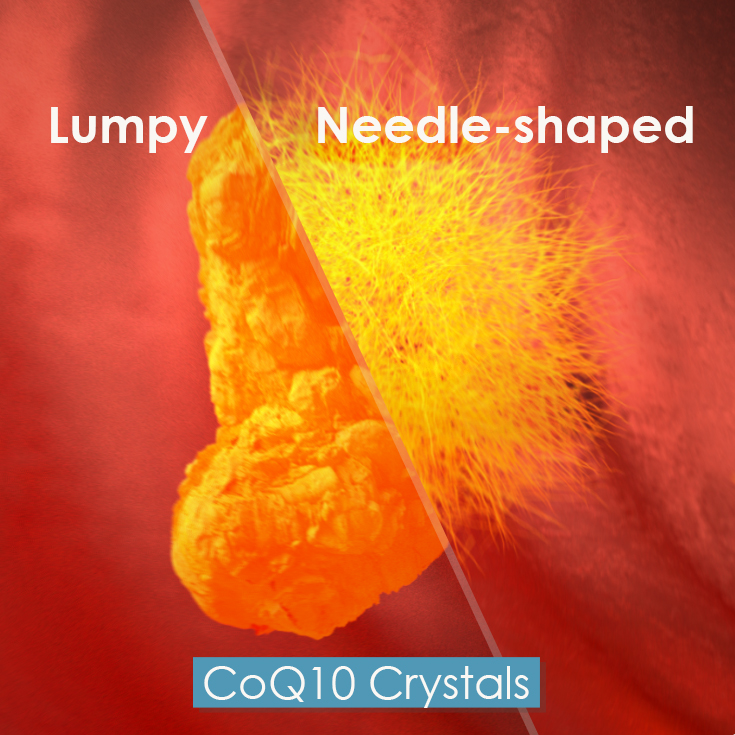
Various CoQ10 products are available either as tablets or as capsules. The CoQ10 content may be in the form of crystals or granules, encapsulated in liposomes, in micelles attached to nanoparticles or dissolved in oil.
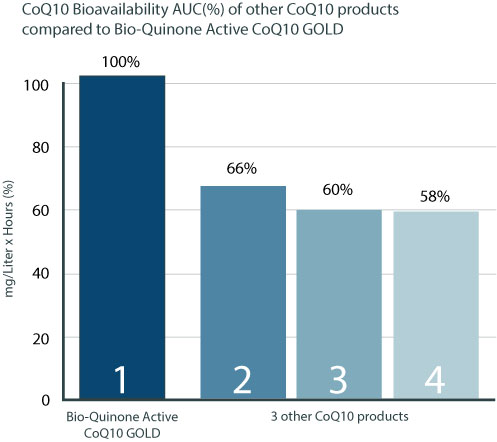
The size alone of the CoQ10 molecule - it has a considerable size, approx. 5.5 nm long and 864 times heavier than a hydrogen atom - means that CoQ10 is basically not an easily absorbed substance. The CoQ10 raw material is an orange brown crystalline powder, and these CoQ10-crystals cannot be absorbed directly into the body. The absorption of unprocessed CoQ10 powder is less than 1%. In addition, CoQ10 is a fat-soluble substance that has to be absorbed in the small intestine along with fat. It is possible to attach other substances to the CoQ10 molecule that will make it somewhat more water-soluble, but doing so will make the big CoQ10 molecule even bigger, whereby the advantage disappears, and the CoQ10 complex will still largely be fat-soluble. It sounds impressive to state that a CoQ10 product is three times more absorbable than a competing product, but if the competing product simply consists of CoQ10 crystals with a less than 1% absorption rate, the claim is not particularly impressive. Producers of CoQ10 supplements have to treat the CoQ10 raw material in a special way in order to achieve an effective absorption. The most bioavailable CoQ10 products are dissolved in a vegetable oil in which the crystals must be dissolved completely.
|
| 3 - Why can I not Feel the Effect of CoQ10? |
|
Most people will experience an effect of CoQ10 supplementation, either directly or indirectly. An example of the latter could be that you suddenly forget to take your usual nap.
Many so-called energy-based products get their effect from caffeine and caffeine-like substances from various plants that stimulate the adrenal glands to secrete stress hormones. Coenzyme Q10, on the other hand, is present in all body cells and is part of the cells’ natural way of producing energy. Thus, the biochemical processes in the body and the experience are not the same for these two different types of products. The fact that you may not feel an immediate effect of CoQ10 may also be due to one or more of the following factors:
- You are taking a CoQ10 product with low bioavailability
- You take your CoQ10 between meals and not together with fat
- You have reduced fat absorption from the gut
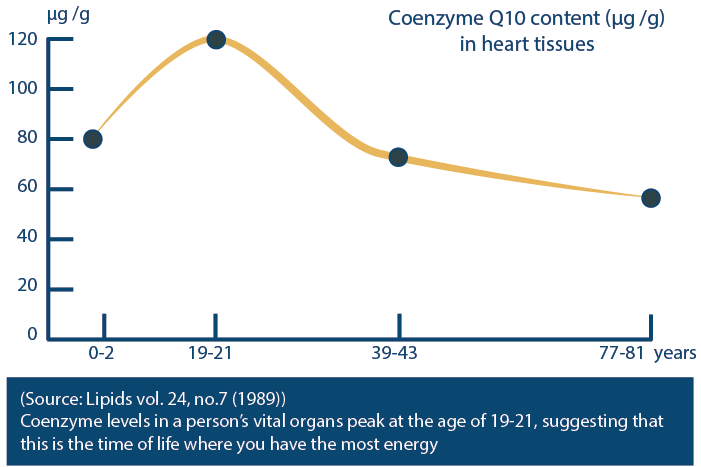
- You are so young that your CoQ10 level is still high
- You are taking medicines that reduce the body's own production of CoQ10 to a degree that requires a higher compensatory CoQ10 dosage
- You take CoQ10 for supper and will therefore only experience the maximum level in the blood at night while you are sleeping (it takes approx. 6 hours from ingestion until CoQ10 enters the blood)
- You need more time. It takes a month or longer before the body's tissues are sufficiently saturated with CoQ10
- You need a higher dose
|
| 4 - How do I Make the Most of my CoQ10 Product? |
|
Since Q10 is a fat-soluble substance, it is important to take it with a meal that contains some fat. If you already take a daily fish oil supplement, it will benefit the absorption of Q10 from the gut to take your Q10 supplements with the fish oil. The effect is observed after a short-term use and is felt most acutely approx. 6 hours after ingestion. Therefore, Q10 should most effectively be taken with breakfast, perhaps lunch. If you take more than 1 capsule of ubiquinone per day, the absorbability will be larger if you spread the dose throughout the day – i.e. 1 capsule at breakfast and 1 capsule at lunch time - rather than taking the entire daily dose at once.
The trace element selenium is part of the seleno protein thioredoxin reductase, which helps in reducing ubiquinone to ubiqionol in the body.
Furthermore, you can take a supplement of the amino acid carnitine, which interacts closely with CoQ10 in the cells' mitochondria. Carnitine helps with the transport of fatty acids into the mitochondria, and CoQ10 is involved in the oxidation process that converts these fatty acids into energy in the form of ATP.
|
| 5 - How do I Optimize the Body's own Production of CoQ10? |
|
It is possible to increase the body's own production of CoQ10 by exercising and by optimizing the intake of nutrients. The cell's production of CoQ10 is a complex process involving many biochemical steps. In order for the body to produce CoQ10, there is a need for a vitamin B complex, vitamins C and E, selenium and magnesium and several trace elements. A lack of one or more of these nutrients will affect the body's CoQ10 production considerably. An increase in available CoQ10 in the body will usually be larger with the aid of even a small daily supplement of CoQ10.
|
| 6 - What are the Best Dietary Sources of CoQ10? |
|
Cereal products usually contain Coenzyme Q9, whereas soybeans do contain some CoQ10. There is also some CoQ10 in walnuts, almonds, oil-rich fruits and green vegetables, especially spinach. Furthermore, fish contains CoQ10, especially sardines, which contain twice as much CoQ10 as beef. Even so, one would have to eat one pound of sardines, two pounds of beef, or 2.5 pounds of peanuts in order to get 30 mg of CoQ10. Typically, there is somewhere between 5-10 mg of CoQ10 in the food we eat on a daily basis. Most individuals probably get around 5 mg a day.
|
| 7 – Are There Adverse Effects from CoQ10? |
|
In studies in which CoQ10 has been tested, daily doses up to 1500 mg have not caused adverse effects of a serious nature. There have only been a very few cases of adverse effects of a mild nature. Symptoms like headache, dizziness, nausea, constipation, diarrhea and indigestion can occur in rare instances. It cannot be excluded, however, that some of these symptoms may originate from the capsule material or added vegetable oil, and not from the CoQ10 itself.
|
| 8 - How Long can I take CoQ10? |
|
CoQ10 is generally considered a very safe substance. Long-term studies of more than 5 years as well as studies with high daily doses have shown that it is safe to take supplements of CoQ10 for a long period. In addition, supplementation of CoQ10 does not reduce the body's own production of the substance. After cessation of supplementation, the body's CoQ10-level returns to the same level as before. This is proof that CoQ10 supplementation does not affect the body's ability to synthesize it. Everything indicates that you can safely continue to take CoQ10 for life.
|
| 9 - What is the Difference between Qxidized CoQ10 (Ubiquinone) and Reduced CoQ10 (Ubiquinol)? |
|
CoQ10 is a redox molecule. It is best known for its oxidized form, ubiquinone, which is the only kind of CoQ10 that has been available as a supplement ever since the first CoQ10 preparations were introduced in Europe shortly after 1990. Globally, ubiquinone has also been the only form of CoQ10 whose effect has been documented in scientific studies, until the introduction of ubiquinol. Ubiquinol, the reduced form of CoQ10, was first brought to the market in 2006. Since then, ubiquinol has been marketed as active CoQ10 although it is not more active than ubiquinone. All in all, there is not much scientific evidence on ubiquinol. In other words: Almost all documentation on the prevention and treatment of CoQ10 deficiency states has been performed with ubiquinone, and this includes research studies using Bio-Quinone capsules.
At the molecular level, the difference between ubiquinone (oxidized CoQ10) and ubiquinol (reduced CoQ10) is not big. Ubiquinol has two extra hydrogen molecules and forms, in conjunction with oxygen, a so-called hydroxyl group on the head of the CoQ10 molecule, which is a quinone ring.
The two forms of CoQ10, however, have quite different roles in the body. Ubiquinol donates electrons, whereas ubiquinone receives electrons. Ubiquinol performs an important function as an antioxidant in the body, but in the cells' energy producing mitochondria, the two forms constantly switch from the one form to the other - that is, from the oxidized to the reduced form and back again. Thus, one cannot say that one form of CoQ10 is more active or more important than the other.
The two forms of Q10 also have different colors. Normal Q10 is a clear orange, yellowish substance, whereas reduced Q10, which is oxidatively unstable, has a milky-white color. It is therefore easy to test whether the product you buy is normal or reduced Q10. The Q10 that we produce in the body's cells is oxidized Q10, whereas 90-95% of Q10 circulating in the blood is in the form of reduced Q10.
CoQ10 from the diet consists of both ubiquinone and ubiquinol, about half of each7. Both forms are absorbed in the intestine along with fat. CoQ10 is slowly transported from the lymph into the blood. Already during the passage through the intestinal wall into the lymph, the absorbed ubiquinone is being converted into reduced ubiquinol. Consequently, there is no good reason to choose a product containing ubiquinol, as your body is able to absorb and convert ubiquinone from the gut to ubiquinol. The body is naturally able to reduce ubiquinone CoQ10 by itself.
CoQ10 product's ability to be absorbed from the intestine is one of its most important aspects. Ubiquinone of good quality has been found to be absorbed better than ubiquinol. A few unsubstantiated reports suggest, however, that products with ubiquinol may be relevant to a very small percentage of people who have impaired uptake of CoQ10 from the gut.
Finally, ubiquinol preparations are usually more expensive to buy than ubiquinone preparations.
|
| 10 - Do Cholesterol Lowering Drugs Reduce the Body's Level of CoQ10? |
|
Yes, you can read about the mechanism in textbooks on human biochemistry. Moreover, there is now a great deal of evidence from scientific studies on the consequences of this effect. The type of medication in question is commonly referred to as "statins". Statins are a class of cholesterol-lowering drugs that act by inhibiting the enzyme HMG-CoA reductase, which reduces the body's production of the substance mevalonate. From mevalonate, several substances are formed in the liver, including cholesterol and CoQ10. You cannot lower the body's cholesterol production in this way without also lowering its production of CoQ10.
There are different types of statins working in different ways, and they are not equally strong. The most common complaint about the adverse effects of statins is muscle pain. The pain occurs when the muscles have to work with too little energy. However, not everybody experiences adverse effects from statins.
The effect differs from individual to individual depending on how much CoQ10 is required to normalize the body's CoQ10 level during statin treatment. You must monitor your own body’s needs.
|
| 11 - How much CoQ10 do We Need? |
|
Our needs for CoQ10 are individual. Healthy young people usually have no need for supplementation of CoQ10. Healthy adults should take maybe 30 - 60 mg daily. Elderly people could take maybe 100 mg daily. People in therapeutic treatment have been given up to 300 mg daily - occasionally even more than that.
|
| 12 - How Long does It take for CoQ10 to Work? |
From the moment you swallow a CoQ10 softgel capsule, which is best absorbed with a meal that contains some fat, it will take 6-8 hours before the CoQ10 is emptied into the blood from the lymphatic vessels. There is also a threshold value for the blood level of CoQ10 that has to be attained before the tissue can absorb the CoQ10 sufficiently. This threshold value of serum CoQ10 has not been established with certainty, but researchers believe that it is approx. 2 - 2,5 ug/ml.
In practical terms, this means that it is advisable to start with a slightly higher daily dose and then reduce the dose after some time if necessary. Take CoQ10 for at least a month, but do not expect maximum absorption in the tissue until after at least six months of use.
|
| 13 - What is the Source of Pharma Nord's Bio-Quinone Active CoQ10? |
|
Pharma Nord's Bio-Quinone Active CoQ10 is extracted from the content produced in specialized yeast cells, but the CoQ10 itself is completely free of yeast components. The reason for the use of yeast as a source of CoQ10 is that we can extract CoQ10, which is completely identical to the form that the body produces itself. Please be aware that there is also synthetic CoQ10 on the market.
|
| 14 - Do I Risk Infection from Mad Cow Disease from the Softgel Capsules? |
|
No. Pharma Nord's CoQ10 softgel capsules are pharmaceutical grade. They are made from cow hides. Risk material such as brain and spine are not used for gelatin production. Moreover, animals from risk countries are not used, and only the hide from cattle approved for human consumption is accepted. In addition, all animals are inspected before and after slaughter in an authorized slaughterhouse prior to approval.
|
| 15 - How can I Avoid Eating the Gelatin in the CoQ10 Capsules? |
|
You can cut a small hole in the softgel capsule with a pair of scissors and squeeze the contents of the capsule out in a spoon or directly into your mouth.
|
| 16 - Is the Gelatin used in Pharma Nord's CoQ10 Capsules Halal Certified? |
Yes. Pharma Nord buys the bovine gelatin for our CoQ10 products from a supplier whose gelatin is Halal certified. The certification comes from the Halal Department of the Islamic and Cultural Centre of Belgium. |